Our services
Private Utility Locating
We find and mark the private underground lines on your property that 811 doesn’t, so you can plan your project around what’s below. Family-owned and based in Indianapolis, we serve Indiana, Ohio, Michigan, Kentucky, and the greater Midwest.
Family-owned
Flat-rate quotes
Scheduled by appointment
Call 811 first
What private utility locating is
When you call 811, the public utility companies mark their own lines, generally up to the meter or the property line. Marking rules vary by state. They do not mark the lines you own.
Private utility locating covers those lines, such as:
- Water and sewer service lines
- Irrigation lines
- Power to a shed or outbuilding
- Gas lines to a pool, grill, or generator
- Drainage and septic components
- Fuel lines and tanks
- Communication lines on private property and campuses
When you need a private locate
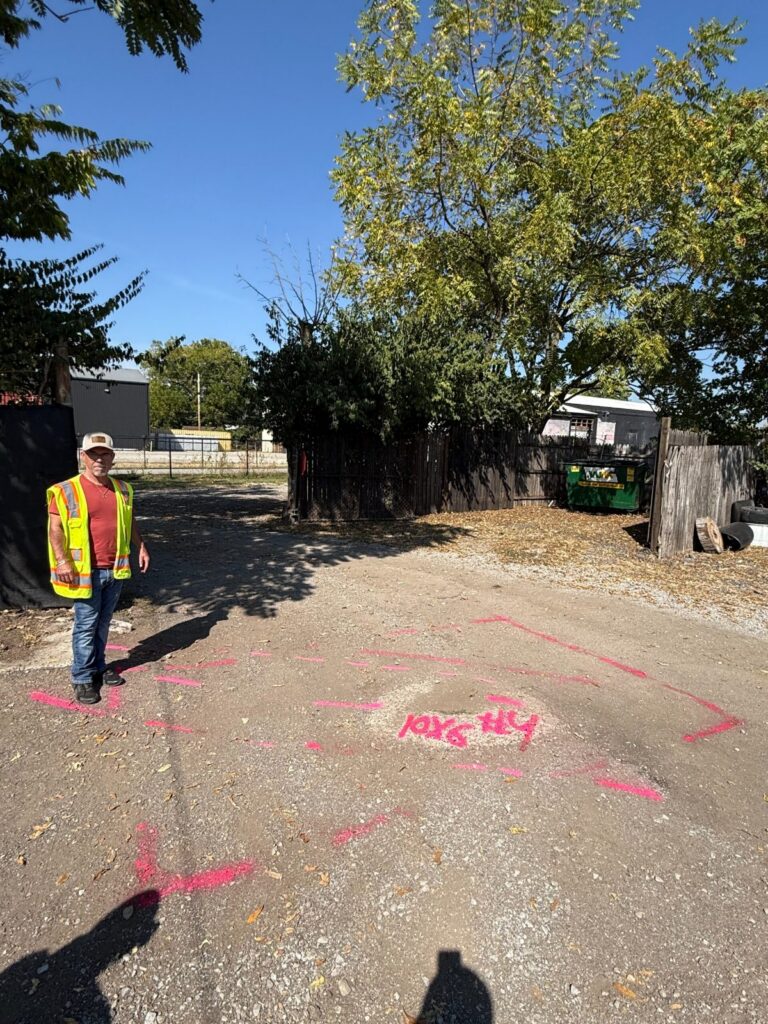
Any project that breaks ground on private property is a good reason to know what’s below first. Common examples:
Fences and decks
Post holes can reach buried lines on private property, so find them before the auger does.
Pools, patios and additions
Excavation can run through the water, sewer, gas, and electric lines that serve the property.
Trenching and new utility runs
Before you trench for a new line, find the lines that are already there.
Tree removal and landscaping
Stump removal, tree planting, and irrigation work all break ground.
Sheds, outbuildings and generators
Power, water, and gas often run out to outbuildings, pools, and generators, and those lines are often private.
Commercial and industrial projects
Campuses, plants, and commercial sites have private lines 811 doesn’t cover. Locate before expansions and new equipment.
How a locate works
Here is what to expect, from your first call to marked lines.
1. Tell us about the job
Send the address, what you plan to dig or build, and your timeline.
2. Get a flat-rate quote
We quote a flat rate based on the scope of the job. We schedule locates by appointment, so give us as much notice as you can.
3. Call in your 811 marks
Please have your 811 marks called in before we arrive, so we can see the full picture on site.
4. We locate and mark
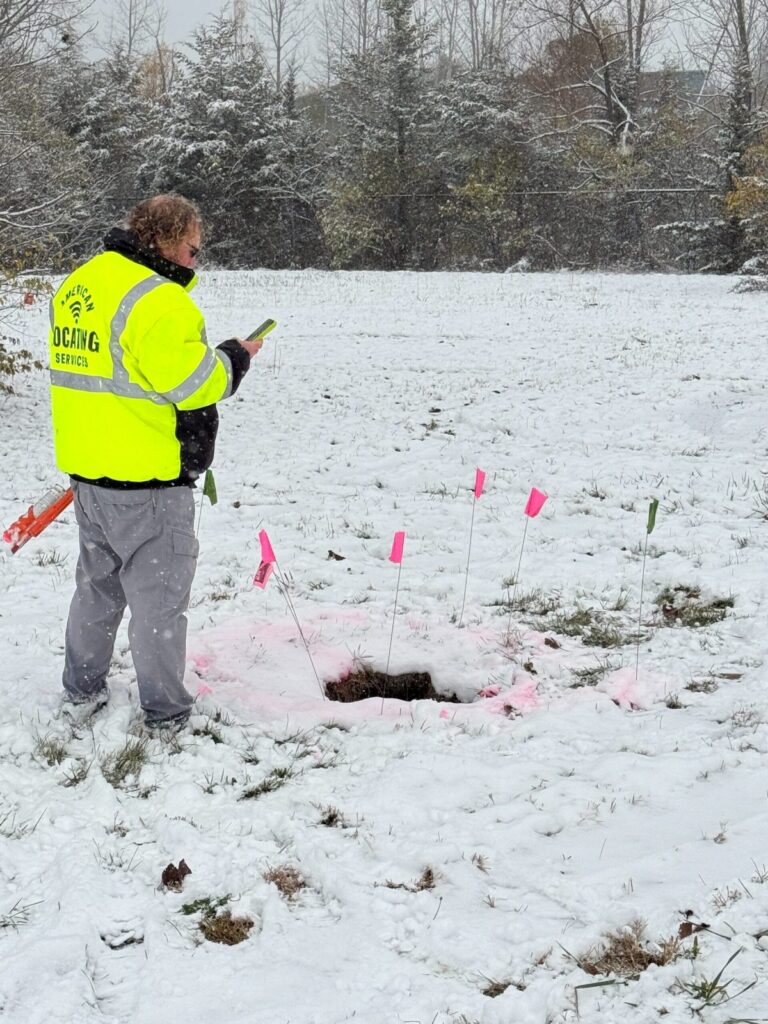
We use the methods that fit your site and mark what we find on the ground.
We use electromagnetic (EM) locators, which detect conductive lines such as metal pipe and cable, and ground penetrating radar (GPR), which can detect non-metallic lines like PVC and clay pipe as well as tanks. Push cameras let us trace and inspect pipes, and GNSS lets us record the position of what we find. We often combine methods, because no single method finds everything.
What we find, and what we don’t
What we can locate
- Conductive lines such as metal pipe and cable, using EM locators
- Non-metallic lines such as PVC and clay pipe, tanks, and other buried features, using GPR when site conditions allow
- Sewer and drain lines, using push cameras
- The position of what we find, recorded with GNSS
Limits you should know about
- Results depend on soil type, moisture, depth, access, and nearby interference. Clay and saturated soil can limit GPR.
- Our marks show the approximate horizontal position of a line. Depth readings are estimates unless the line is exposed by hand-digging or vacuum excavation.
- A utility locate is not a property boundary survey. Property lines are set by a licensed land surveyor.
Safety first
Call 811 first. Then call us.
A private locate does not replace 811. Before any digging, request your 811 locate so the public utilities are marked. We ask that your 811 marks be called in before we arrive, so we can see the full picture on site.
When you dig, follow your state’s rules for working near marked lines, treat every line as live, and never dig on a guess.
Family-owned, and careful with the details
American Locating Services was founded in 2000 by Jeff Clem, who still owns it and has worked in the locating industry for more than 30 years.
We take the time to get the details right so the marks and notes you receive are clear and usable, and we quote a flat rate based on the scope of the job.
Common questions
Does 811 mark private lines?
No. 811 notifies public utility owners, who mark their own lines. Lines you own, such as water and sewer service lines, irrigation, and gas lines to a pool or grill, are typically not marked. That’s where private locating comes in.
If I hire you, do I still need to call 811?
Yes. Private locating complements 811. It doesn’t replace it. Please have your 811 marks called in before we arrive.
How much does a private locate cost?
We quote a flat rate based on the scope of the job. Send us the address, the type of work, and your timeline, and we’ll quote it.
How soon can you come out?
We schedule locates by appointment and typically can’t do same-day visits, so call or text us as soon as you know your dig date.
Can you find non-metallic lines like PVC?
Often, yes. Ground penetrating radar can detect non-metallic lines such as PVC and clay pipe, as well as tanks, though soil type and moisture can limit how well it works. We use the methods that fit your site and tell you what we found and any limits on what we could detect.
Is a utility locate the same as a property survey?
No. We find and mark underground utilities. A utility locate is not a property boundary survey, and we don’t perform boundary, topographic, or other land surveys. Property lines are set by a licensed land surveyor.
Ready to schedule a private locate?
Tell us about your job and we’ll send a flat-rate quote based on the scope of the work. We schedule locates by appointment, so the more notice you can give us, the better. Please have your 811 marks called in before we arrive.
Related services: GPR scanning · Sewer and water line locating · Surveying, mapping and drone · All services
We’re not an emergency response service. If you smell gas or have struck a line, leave the area and call 911 and your utility’s emergency number.